Explaining Overtime Regulations in the UAE
In the United Arab Emirates (UAE), employees working beyond their regular hours might be eligible for overtime compensation, according to the country’s Labour Law, specifically Federal Decree-Law No. 33 of 2021 and its accompanying regulations. These laws define the scope of maximum working hours and outline the computation of overtime pay, while also identifying employees who are exempt from these working hour restrictions.
Defining Standard Working Hours
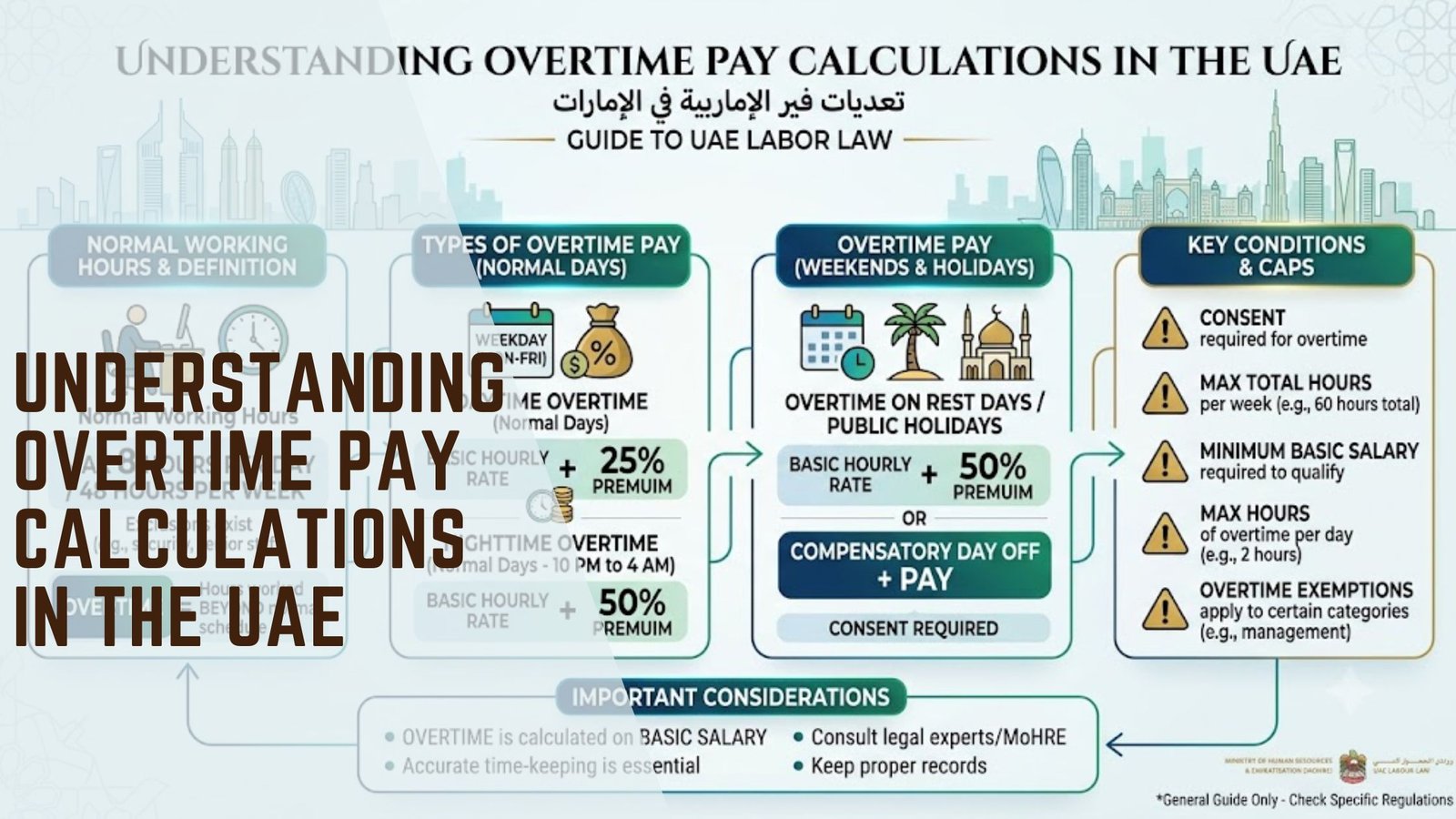
The UAE Labour Law, under Article 17, stipulates that the maximum standard working hours for private sector employees are capped at eight hours per day or 48 hours per week. Notably, the UAE Cabinet holds the authority to modify these hours for certain sectors or categories of workers based on proposals from the Minister of Human Resources and Emiratisation, coordinated with relevant authorities.
Exceptions Including Commute Time
Typically, commute time is excluded from working hours. Nevertheless, Cabinet Resolution No. 1 of 2022 specifies exceptions where commute time may be considered part of working hours. These exceptions include delays due to adverse weather conditions, employer-provided transportation disruptions due to accidents or mechanical failures, or mutual agreement between employer and employee as stated in the labour contract.
Overtime Hour Limitations
Work performed beyond the standard working hours is recognized as overtime. Article 19 of the UAE Labour Law permits employers to request overtime from employees, limiting additional work to two extra hours per day. However, there are exceptions.
Exceptional Circumstances
In scenarios where extended work is crucial to avert substantial loss or accidents, as outlined in Article 15 (3) of Cabinet Resolution No. 1 of 2022, employees may be required to work longer hours. Despite these exceptions, the total working hours must not surpass 144 hours over a three-week period.
Calculating Overtime Pay
Overtime compensation is based on the employee’s basic wage, not the total salary. This wage is specified in the offer letter and employment contract. Employees working overtime are entitled to their basic wage plus an additional 25% for extra hours worked. For overtime between 10 p.m. and 4 a.m., employees receive an additional 50% of their basic wage, excluding shift workers from this rule.
Weekend and Day Off Work
When employees work on their designated days off, they are entitled to a substitute rest day or compensation equivalent to regular pay plus a 50% increase of their basic wage for the overtime duration.
Eligibility for Overtime Payments
Article 15 (4) of Cabinet Resolution No. 1 of 2022 specifies various roles exempt from maximum working hour provisions. These include board directors, individuals in supervisory roles with employer authority, naval vessel crews, seafarers with unique service conditions, and roles requiring continuous shifts due to technical demands—provided the average workweek does not exceed 56 hours. Additionally, preparatory or supplementary tasks performed outside designated work hours are also exempt.