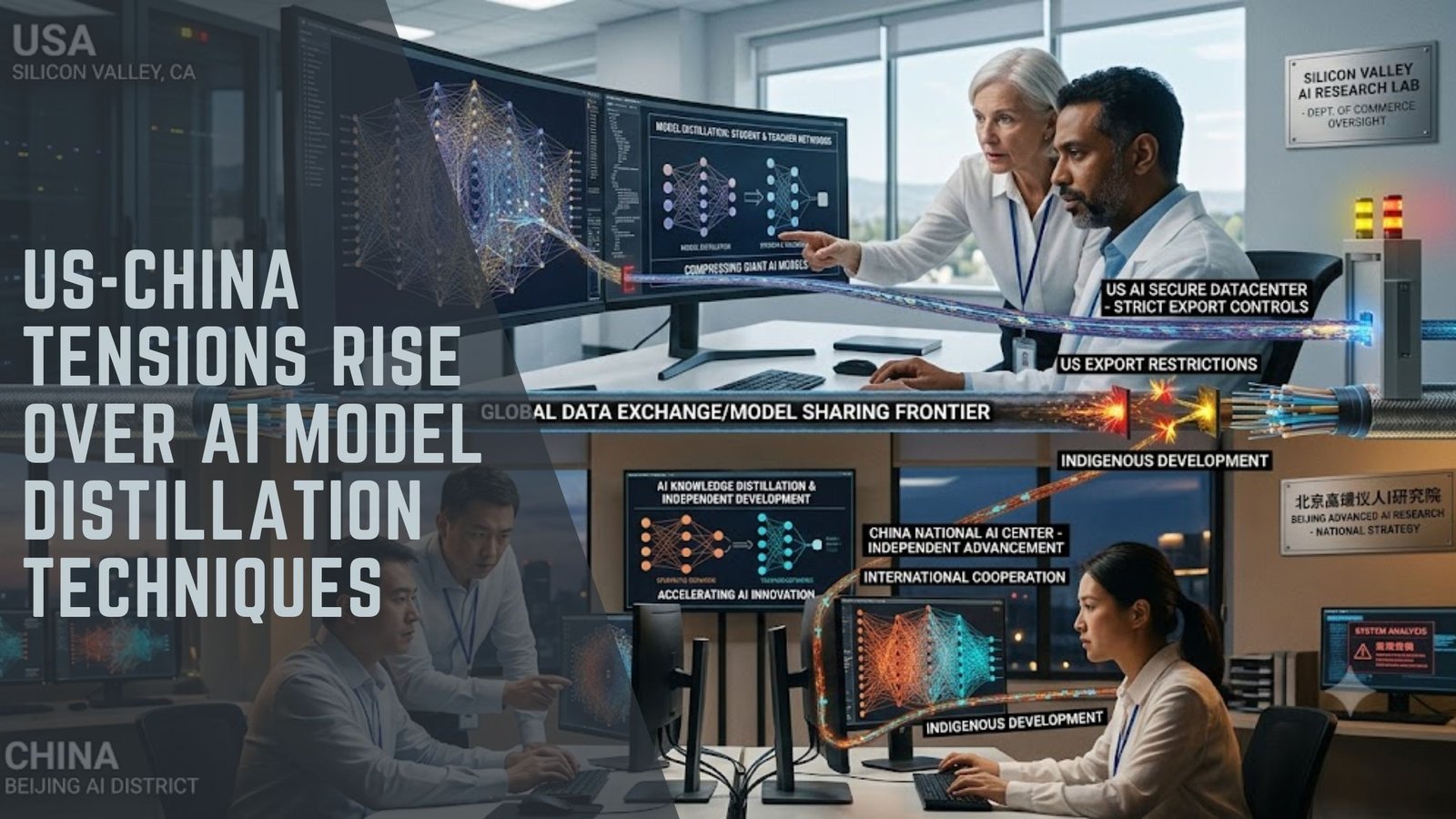
In the ongoing technological rivalry between the United States and China, a sophisticated method of refining artificial intelligence models, known as model distillation, has emerged as a contentious issue. This technique, which allows the transformation of large and resource-intensive AI systems into smaller, more efficient versions, is now a focal point of dispute in the quest for AI supremacy.
Understanding Model Distillation
Model distillation is a process that involves utilizing a high-capacity ‘teacher’ AI model to train a smaller ‘student’ model, effectively transmitting certain abilities without replicating the entire original system. The teacher model provides examples—such as solutions or code—that the student model uses for training, allowing it to execute specific tasks with greater efficiency and reduced computational demands.
Unlike creating a direct copy, the student model absorbs selected behaviors from the teacher model. This approach helps in preserving essential functionalities while minimizing the need for extensive computational infrastructure typically required by frontier models, which are the most advanced and computationally heavy AI systems.
Significance of Model Distillation
The value of model distillation lies in its capacity to democratize AI deployment, making it financially feasible and accessible. Large AI models demand substantial data processing capabilities and specialized hardware, making them costly to operate. Through distillation, AI can be implemented in more cost-effective environments, including smaller devices, localized networks, and specific industrial applications.
This process is particularly attractive to organizations and governments aiming to integrate AI into various sectors, such as manufacturing, automotive, and telecommunications, without the prohibitive costs associated with running full-scale models.
The Role of Reasoning Traces
A recent development in AI distillation involves the inclusion of reasoning traces, which not only convey the final outcomes but also the logical steps undertaken to achieve those results. These traces provide deeper insights into problem-solving methodologies, offering a more comprehensive learning experience for the student model. Florian Tramèr, an expert in machine-learning security, likens this to educational techniques where detailed explanations enhance understanding more effectively than simple solutions.
The growing importance of reasoning traces has heightened sensitivity around AI outputs, as they could potentially reveal the intricate processes used by advanced AI models to address complex challenges.
Widespread Adoption of Distillation
Model distillation is a well-established practice within the AI research community. Esteemed institutions and tech companies in the U.S., like Stanford University and Microsoft, have utilized this method to refine and enhance AI capabilities. Similarly, Chinese researchers have employed distillation using U.S. model outputs for initiatives such as developing Chinese-language AI models.
The distinction in distillation practices often comes down to access. Open-weight models allow modification and examination of their components, whereas closed models, such as those from OpenAI and Anthropic, are controlled by the respective companies and accessed through limited interfaces.
A Flashpoint in US-China Relations
The burgeoning tension between the U.S. and China over AI is less about the distillation technique itself and more about the unauthorized acquisition of capabilities. U.S. firms allege that Chinese entities are systematically extracting knowledge from proprietary models. Companies like Anthropic claim that organizations such as DeepSeek and MiniMax in China are engaging in large-scale efforts to replicate abilities from their models, focusing on areas like software development and advanced problem-solving.
OpenAI has also reported attempts by Chinese actors to exploit its models for distillation purposes. However, no reciprocal accusations have been made by Chinese companies against their U.S. counterparts regarding similar practices.
Conclusion
As the strategic competition for AI dominance intensifies, model distillation has become emblematic of broader issues concerning intellectual property rights and technological sovereignty. Both nations are navigating a complex landscape where innovation, security, and competitive advantage intersect, making AI model distillation a significant topic in international tech relations.