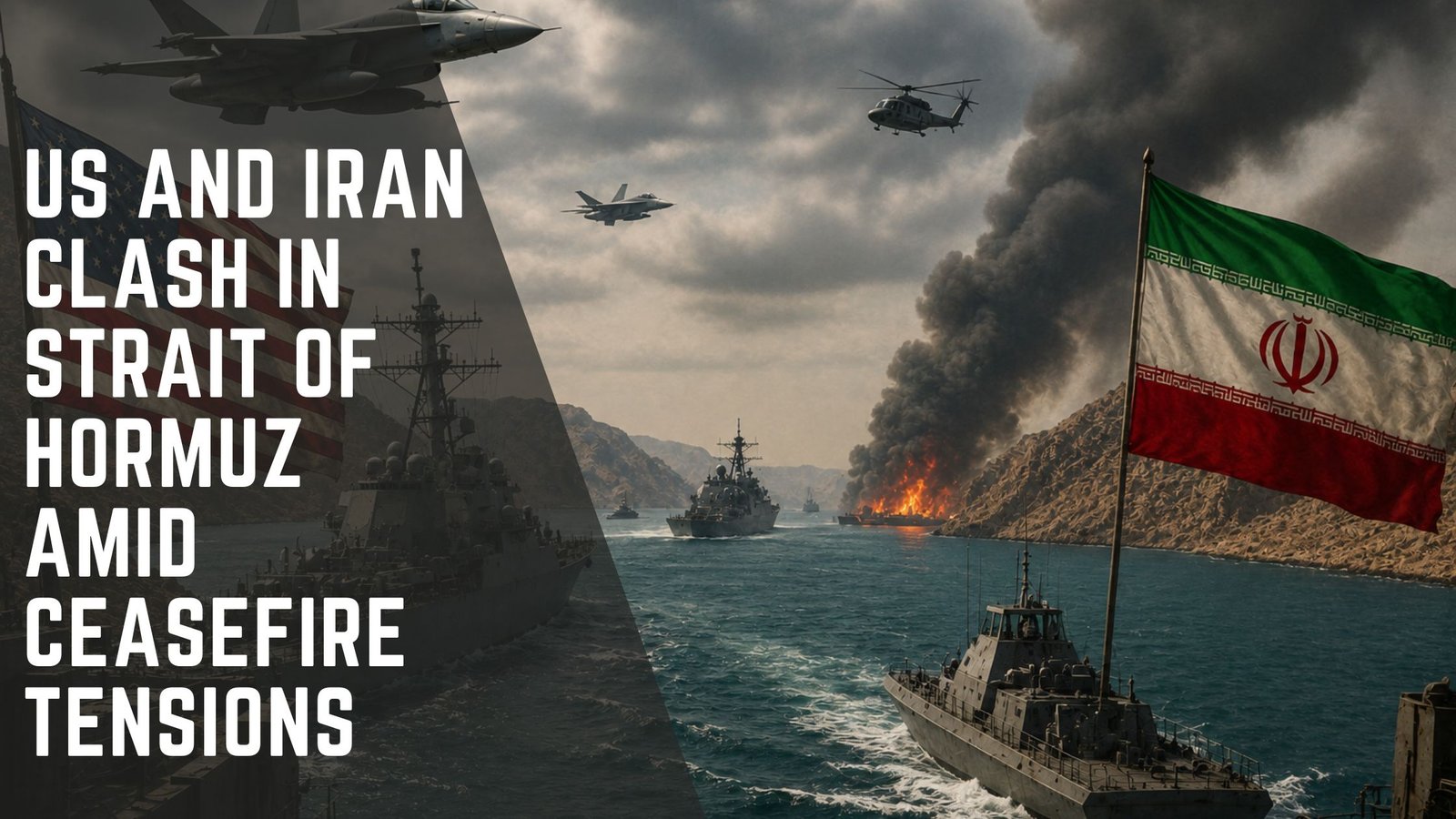
The United States executed a military strike against Iran on Friday, responding to an alleged Iranian drone assault on a cargo vessel navigating the strategic Strait of Hormuz. This confrontation has escalated tensions between the two nations, each accusing the other of breaching the terms of a recently established ceasefire.
US Military Response
The U.S. Central Command confirmed that American aircraft targeted key Iranian military assets, including missile depots, drone storage facilities, and coastal radar installations. A U.S. official stated that the operation has been completed, while Iran reported that a projectile impacted the vicinity of a pier in Sirik, southern Iran. In retaliation, Iran’s naval forces claimed to have targeted U.S. military positions in the region.
Regional Developments
Amidst these tensions, a breakthrough occurred as Israel and Lebanon formalized an agreement to conclude hostilities involving Israel and the Hezbollah faction, which is backed by Iran. The agreement, regarded as a preliminary step, proposes Hezbollah’s disarmament and the withdrawal of Israeli troops from Lebanese territories. However, the enforcement mechanisms of this deal remain uncertain, with Hezbollah expressing reluctance to comply.
Strait of Hormuz Under Scrutiny
Iran reiterated its stance on controlling the Strait of Hormuz, cautioning Gulf states against siding with the U.S. following the Thursday attack on a cargo ship near Oman. President Donald Trump attributed the assault to Iran, declaring it a violation of the ceasefire agreement reached the previous week.
In a statement, U.S. Central Command emphasized, “The unwarranted aggression against commercial shipping by Iranian forces clearly violated the ceasefire,” labeling the military strikes as “a powerful response to yesterday’s attack on a commercial ship transiting the Strait of Hormuz.” The U.S. military committed to maintaining “safe passage coordination and support” for commercial vessels traversing the strait.
Diplomatic Standoff
U.S. Vice President JD Vance, previously skeptical of U.S. interventions in Iran, stated that the Trump administration has adhered to the ceasefire agreement, also known as a memorandum of understanding. Vance remarked on social media, “Iran signed a ceasefire agreement. We have honored it. If they have disagreements about how the MOU is being applied, they can pick up the phone. But violence will be met with violence.”
Iranian state media, referencing an unnamed military source, reported an attack on the port of Sirik following an explosion. The source alleged that warning shots were fired from Sirik towards vessels infringing on regulations within the Strait of Hormuz, with two warning missiles launched from the Karpan area towards the strategic waterway.
The Revolutionary Guards asserted that their navy targeted locations where the “terrorist U.S. military” is stationed, cautioning that any further U.S. aggression would prompt a more extensive response.
Economic Impacts
Prior to the outbreak of renewed violence, global oil prices saw a decline of approximately 3% on Friday, poised for significant weekly losses. This shift came as oil tankers resumed operations through the Strait of Hormuz, a critical chokepoint for about 20% of worldwide oil and liquefied natural gas supplies.
Saudi Aramco resumed crude loadings at its Ras Tanura terminal in the Gulf, the largest oil port globally, following a nearly four-month suspension, according to shipping data. Additionally, the transport of fertilizers through the strait has increased, alleviating concerns over potential spikes in global food prices.
International Reactions
U.S. Secretary of State Marco Rubio, concluding a diplomatic tour of the Gulf aimed at reassuring regional allies about the interim agreement, released a joint statement with the Gulf Cooperation Council advocating for “free, unconditional, and unrestricted navigation” in the strait, devoid of tolls or “attempts to assert control.”