Powerful Earthquake Hits Southern Japan
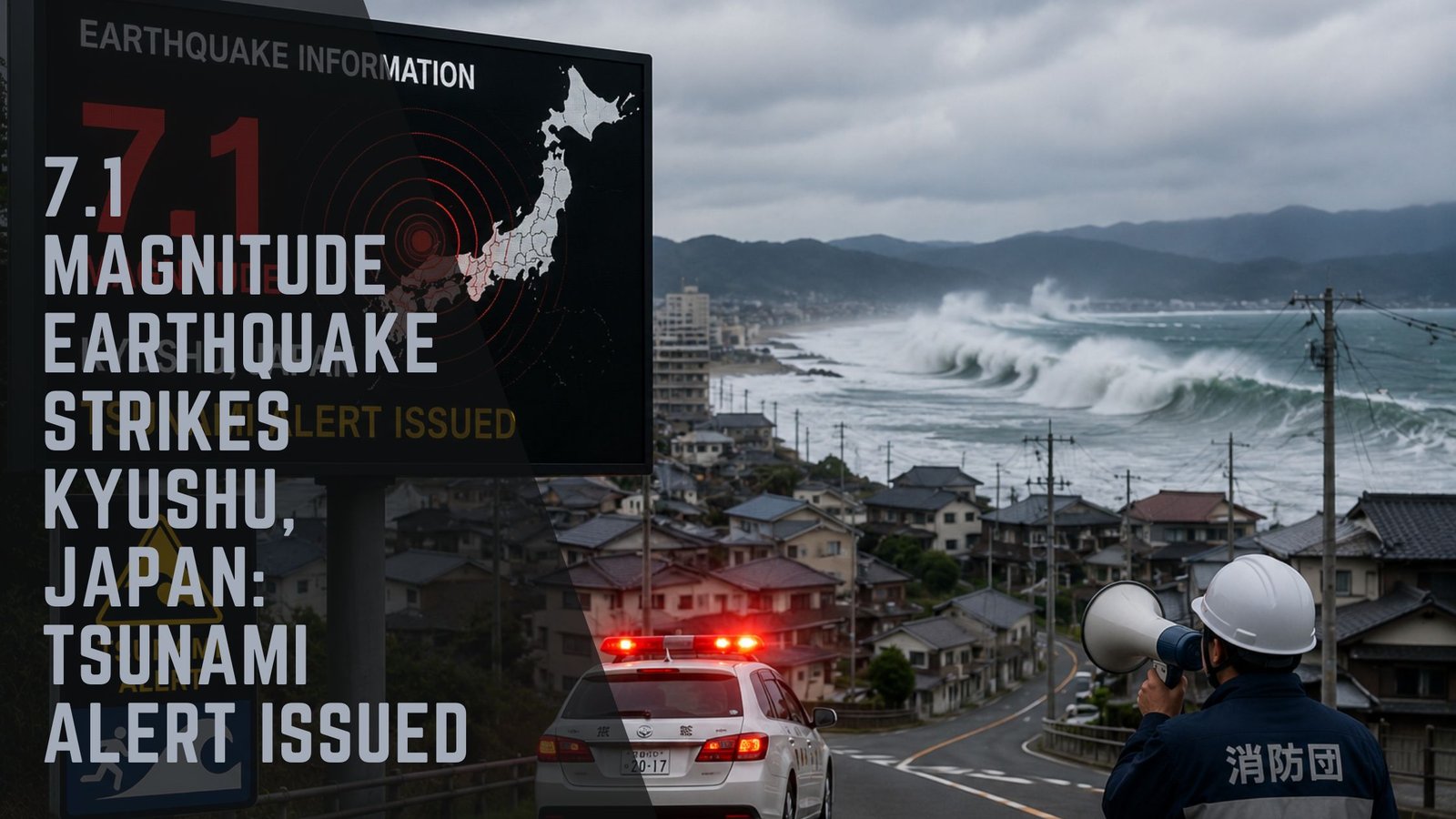
An earthquake measuring 7.1 on the Richter scale has struck the southern region of Kyushu in Japan, specifically affecting the Kumamoto Prefecture. As a result, the Japan Meteorological Agency (JMA) has issued a tsunami warning, anticipating waves as high as one meter (approximately 3.28 feet).
Tsunami Warning and Affected Areas
The tsunami warning encompasses the prefectures of Kumamoto, Nagasaki, Kagoshima, Fukuoka, Saga, Oita, and Miyazaki, all situated on Japan’s southernmost island, Kyushu. Authorities are urging residents to stay vigilant and follow any safety guidelines provided by local officials. This precautionary alert is a standard procedure in a nation that experiences frequent seismic activity.
Seismic Activity in Japan
Japan’s geographical position along the Pacific Ocean’s ‘Ring of Fire’ makes it particularly susceptible to earthquakes. This region is characterized by a high level of tectonic activity, including numerous volcanoes and oceanic trenches. Statistically, Japan is responsible for about 20% of the world’s earthquakes with magnitudes of 6.0 or higher, underscoring the frequency and potential severity of such events.
Infrastructure and Safety Measures
In the wake of the earthquake, Kyushu Electric Power reported no anomalies at the Sendai and Genkai nuclear power plants, assuring the public of their safety. Additionally, JR Kyushu, the regional train operator, has temporarily halted services, including the high-speed Shinkansen trains, as a precautionary measure to ensure passenger safety.
Emergency Response and Public Safety
The Japanese government has activated emergency response protocols to address the situation. This involves coordinating with local governments to provide timely information and support to the affected communities. Emergency services are on standby to assist with any potential evacuations and to manage the aftermath efficiently.
Public Preparedness and Historical Context
Japan has a well-established system for dealing with earthquakes, including public education campaigns and rigorous building codes designed to withstand seismic shocks. The country’s history with natural disasters has fostered a culture of preparedness and resilience. Residents are encouraged to have emergency kits ready and to be familiar with evacuation routes and procedures.
International Implications and Monitoring
Given Japan’s significant role in the global economy, any major natural disaster can have international repercussions. Financial markets, particularly in Asia, are closely monitoring the situation for any potential impact. Additionally, international agencies are on alert to provide assistance if required.
Ongoing Monitoring and Updates
The situation is being continuously monitored by the Japan Meteorological Agency, and updates will be provided as more information becomes available. Citizens are advised to stay tuned to official channels for the latest developments and instructions.
While the immediate damage assessment is ongoing, the focus remains on ensuring the safety of residents and mitigating the effects of this natural event. The resilience of Japan’s infrastructure and its people will be crucial in managing the consequences of this earthquake.