Introduction: A High-Profile Case Revisited
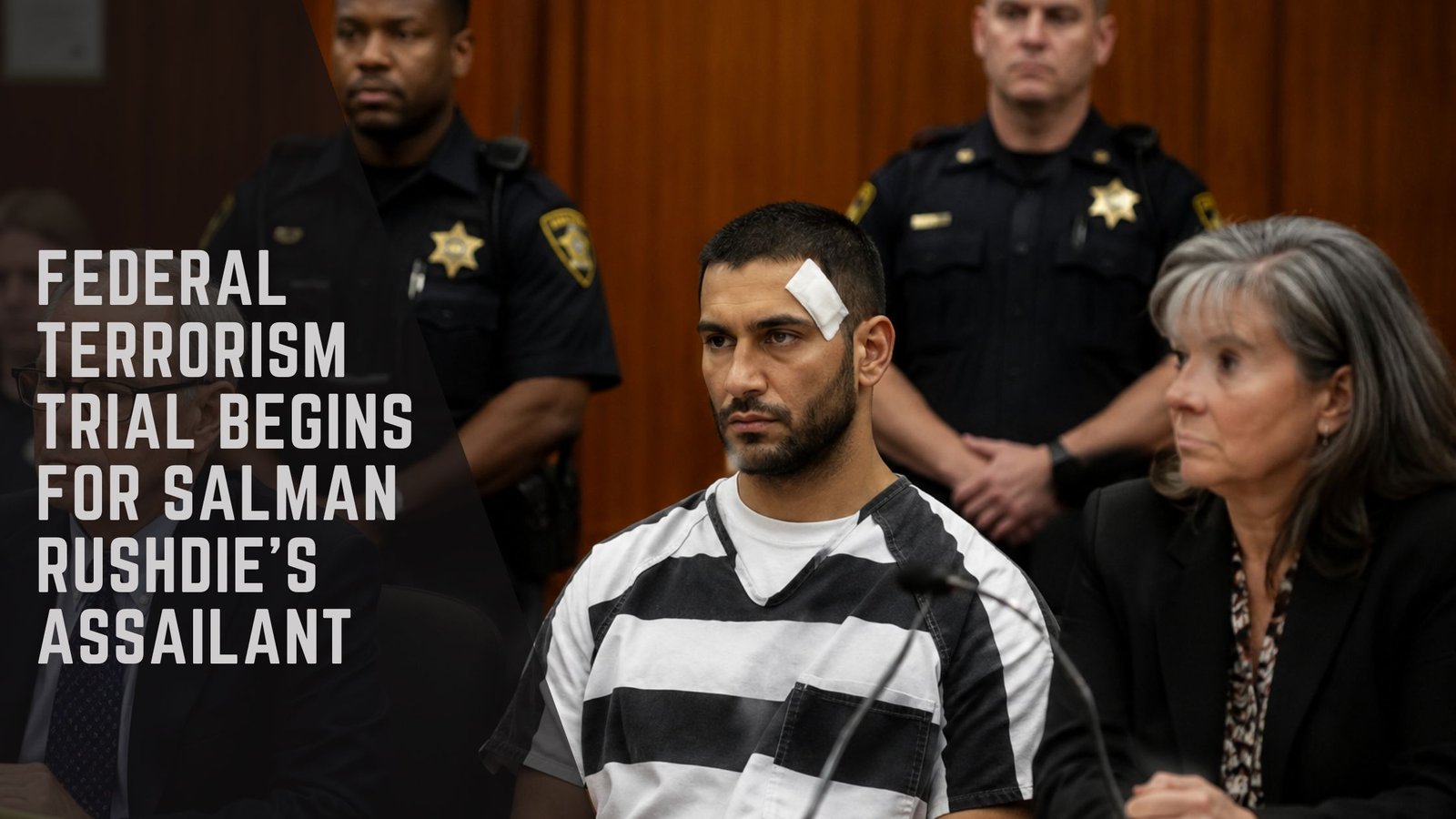
The federal terrorism trial of Hadi Matar, who was previously convicted for attempting to murder renowned author Salman Rushdie, is set to commence with opening statements scheduled for Wednesday. This trial, held in Buffalo, New York, aims to delve deeper into the motivations behind the 2022 attack that took place during a lecture on writer safety.
Background of the Incident
Salman Rushdie, a celebrated author known for his Booker Prize-winning novel “Midnight’s Children,” was attacked on stage at an arts retreat approximately 70 miles from Buffalo. The incident left Rushdie, who is now 79, gravely injured and blind in one eye. He has vividly recounted the attack in various formats, including court testimonies and his memoir.
Rushdie’s controversial book “The Satanic Verses” has been a point of contention since its publication in 1988, leading to a fatwa from Iran’s late Ayatollah Ruhollah Khomeini, calling for his death due to perceived blasphemy.
The Federal Trial and Its Significance
While Matar is already serving a 25-year sentence following a state-level attempted murder conviction, the federal trial is set to address broader concerns about transnational terrorism. Prosecutors allege that Matar, motivated by allegiance to Iran’s theocratic regime and Hezbollah, acted upon the longstanding fatwa against Rushdie.
The trial will explore evidence including Matar’s digital footprints, which reportedly contain extensive research about the fatwa and potential plans for executing the attack. Additionally, federal agents uncovered photographs of Khomeini and his successor, Ayatollah Ali Khamenei, in Matar’s home.
Defense and Prosecution Strategies
Matar has pleaded not guilty to the federal charges, which include engaging in an act of transnational terrorism. His defense team, led by attorney Nathaniel Barone, has challenged the admissibility of some digital evidence, arguing that government investigations were overly broad.
During previous proceedings, Matar articulated a belief in free speech while simultaneously criticizing Rushdie as “a hypocrite.” His defense team has not disclosed whether Matar will testify in the federal trial.
Implications and Wider Context
The case highlights ongoing geopolitical tensions, with Iran’s government denying involvement in the attack yet expressing views that suggest Rushdie provoked violence by insulting Islam. Matar’s actions are perceived as part of a larger pattern of violence linked to ideological extremism.
Matar’s background, as a dual citizen of the U.S. and Lebanon, where Hezbollah is based, adds complexity to the narrative. His mother has noted a change in his demeanor after a trip to Lebanon in 2018, suggesting potential radicalization influences during that period.
The Legacy of Rushdie and “The Satanic Verses”
Despite the threats against his life, Rushdie has continued to contribute to literature and advocacy for free speech. His resilience is exemplified in his recent works, including a memoir detailing the stabbing and a new collection of fiction, “The Eleventh Hour.” In recognition of his contributions, he received the Dayton Literary Peace Prize’s lifetime achievement award.
Conclusion: A Case with Far-Reaching Implications
The outcome of Matar’s federal trial is anticipated to have significant implications for how acts of ideologically motivated violence are prosecuted and understood within the context of international relations and free expression. As the trial unfolds, it serves as a reminder of the enduring impact of Rushdie’s work and the complex interplay between literature, politics, and cultural identity.