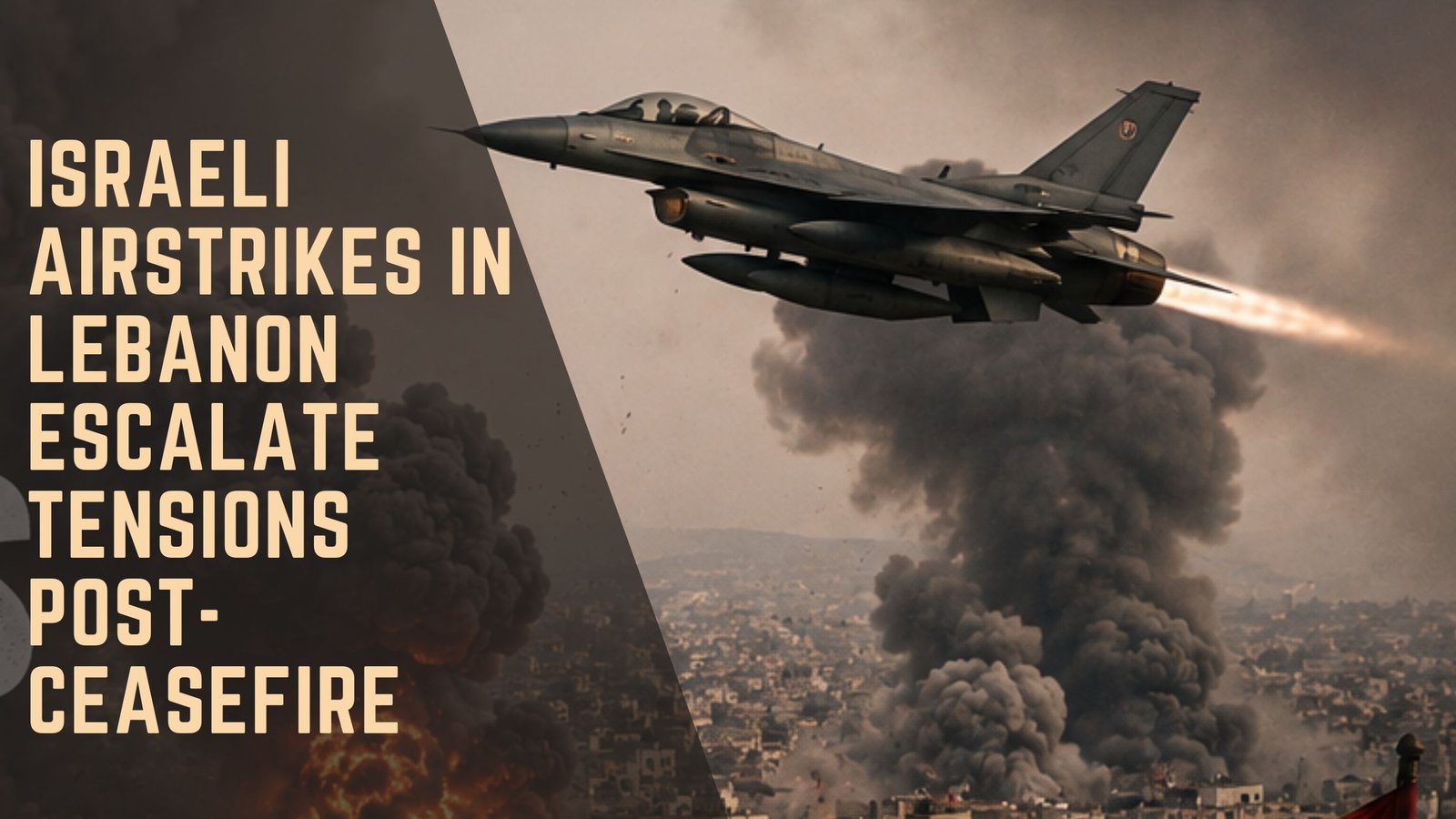
BEIRUT/JERUSALEM: In a development that underscores the fragility of the recently established ceasefire, Israeli airstrikes in Lebanon have resulted in the deaths of at least 10 individuals on Saturday. The attack came shortly after a truce with Hezbollah was implemented, with Israel citing retaliation to rocket fire from the Iranian-backed group.
Renewed Violence Following Ceasefire
The Lebanese National News Agency (NNA) reported that the Israeli military conducted air raids using both warplanes and drones, targeting several locations in the southern regions and the Bekaa Valley of Lebanon. The Israeli military has justified these actions as a response to over 50 projectiles fired by Hezbollah at Israeli forces stationed in southern Lebanon, although Hezbollah has not officially claimed responsibility for the attack.
Hezbollah’s Stance
A high-ranking Hezbollah official, speaking to Reuters, expressed the group’s determination to restrict Israeli military operations within what it considers occupied Lebanese territory. The official emphasized that resistance is deemed legitimate as long as Israeli forces remain present in Lebanon.
Impact on Regional Stability
The violence has once again highlighted the tenuous nature of the ceasefire, which was intended to curb the escalating tensions. This truce forms a crucial part of a broader peace initiative involving the United States and Iran, aimed at achieving a cessation of hostilities in Lebanon.
Civilian Casualties
One of the most devastating strikes occurred in the town of Barish, located in the Tyre district, where a residential building was hit, resulting in the deaths of a family of four. The Lebanese army also reported that an Israeli strike claimed the life of a soldier on the Kfarrumman-Nabatieh road, accusing Israel of undermining efforts to stabilize the region.
Israel’s Position
According to Israel’s Arabic-language military spokesperson, calm can be restored if Hezbollah ceases its hostile activities and respects existing agreements. The spokesperson asserted that Israel’s military presence in the region is targeted at dismantling Hezbollah’s infrastructure and not at harming civilians.
Ceasefire Agreement and Casualties
The ceasefire agreement, facilitated with the help of U.S. diplomacy, took effect on Friday at 4 p.m. (1300 GMT), as confirmed by officials from Israel and Hezbollah. Despite this, the Lebanese health ministry reports that since March 2, Israeli operations have resulted in the deaths of 3,912 individuals, including women, children, and medical personnel. In contrast, Israeli authorities report the loss of 32 soldiers and four civilians during the recent hostilities.
Challenges to Peace Efforts
The newly brokered understanding between the U.S. and Iran calls for an immediate cessation of military activities by all involved parties, including their allies across multiple conflict zones, such as Lebanon. However, Israel, which was not a participant in these negotiations, has voiced concerns that the agreement might limit its military operations in Lebanon, a point of contention that could complicate peace efforts.